
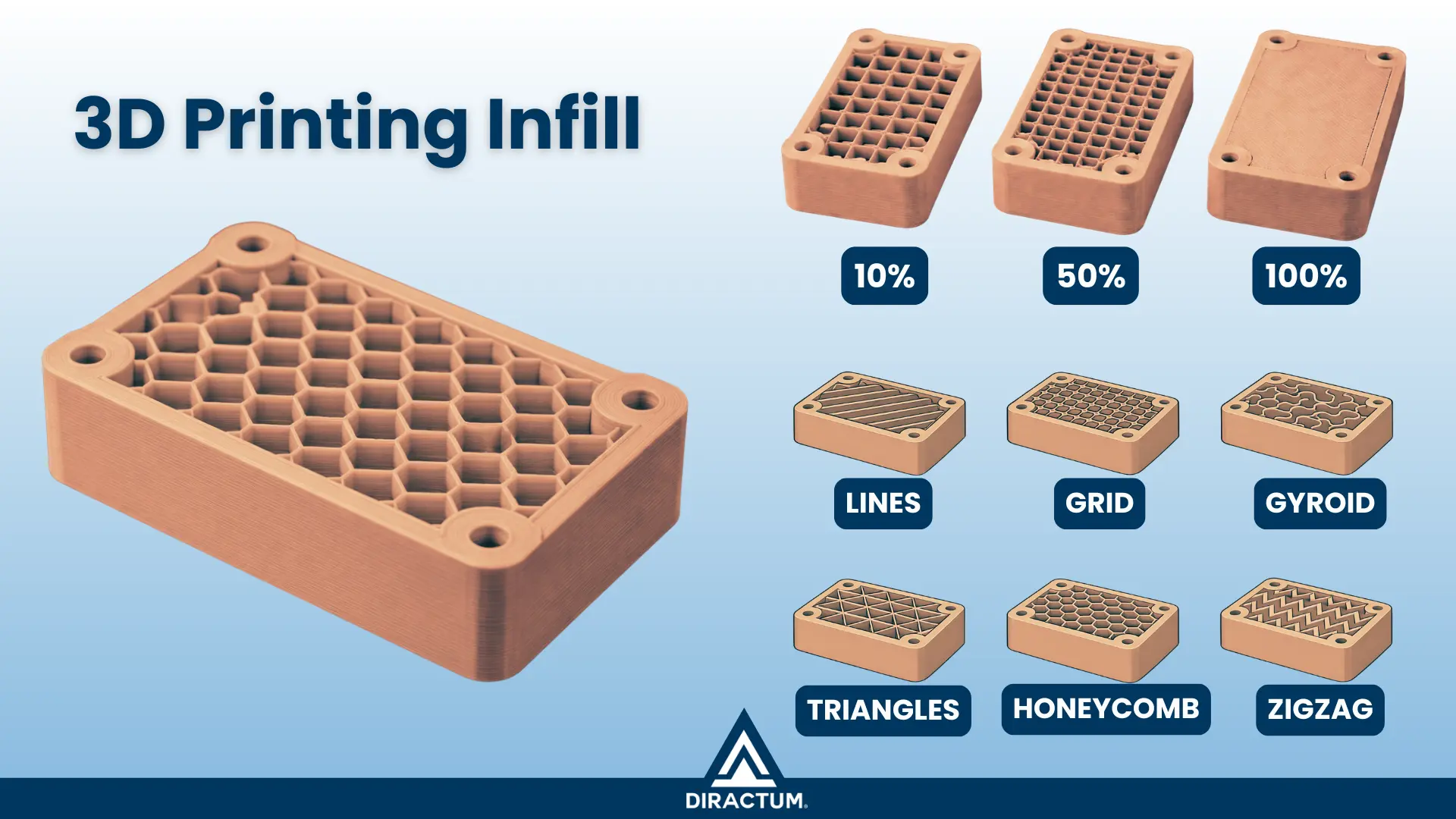
Infill is the internal structure of a 3D printed part, located between its external walls. Its primary function is to provide mechanical strength, control the part's weight, manage material consumption, and optimize printing time.
How to Choose the Right Infill Percentage? The percentage defines the density of your part's interior:
Low Infill (0-10%): Primarily used for visual parts or rapid prototypes that will not endure mechanical stress.
Medium Infill (15-30%): The most common standard for general-use prints. (Visually represented at the 50% level).
High & Semi-Solid Infill (40-100%): Highly recommended for functional parts requiring maximum mechanical resistance.
What are Infill Patterns? Infill patterns refer to the internal geometry printed inside a part. They determine how loads are distributed and dictate the part's overall rigidity, allowing you to achieve high mechanical performance without needing a fully solid print. The most popular patterns include:
Lines and Zigzag (Great for fast printing).
Grid and Triangles (High two-dimensional strength).
Honeycomb and Gyroid (Excellent for three-dimensional load distribution).
At DIRACTUM, we help you master these settings so every 3D print achieves the perfect mechanical performance.