Frequently asked questions
1. What is digital manufacturing?
Use of technologies such as 3D printing, 3D scanning and digital modeling to manufacture parts efficiently and customized, on demand.
2. What is 3D modeling?
It is the process of creating a three-dimensional digital version of a part/object, drawing or sketch, for mechanical analysis or manufacturing.
3. What is 3D scanning?
Technology that captures the shape of a physical object to create its exact digital model.
4. Can a part be recreated without having the design or blueprints?
That is reverse engineering: we scan the part, digitize it and improve or reproduce it with 3D printing. Ideal for replacements, redesigns or quick improvements.
5. What is reverse engineering?
It is the process of digitizing existing parts through 3D scanning or 3D modeling, to reproduce, improve or redesign them using 3D printing.
6. What is 3D printing?
It is a manufacturing method that consists of adding material to build objects layer by layer from a digital file. Unlike traditional processes, it allows greater design freedom, optimizes material use and significantly reduces production waste.
7. What is resin 3D printing?
It is a 3D manufacturing method that uses technology with a light source to harden a liquid resin, creating 3D objects with fine details and high precision. Most common 3D printer types for resin: SLA/DLS, DLP, MSLA.
8. What is filament 3D printing?
It is the best-known additive manufacturing method, also called FDM or FFF, which uses thermoplastic filaments such as PLA, ABS, PETG or PA to manufacture three-dimensional parts layer by layer.
9. What is powder-based 3D printing?
Uses plastic or metal powder fused by heat (laser or electron beam) or binder for resistant industrial parts. This technology produces complex and detailed geometries without the need for supports.
Some techniques include:
- PBF: Powder Bed Fusion
- SLS/SLM/DSLM: Selective Laser Sintering
- MJF: Multi Jet Fusion
- SAF: Selective Absorption Fusion
- EBM: Electron Beam Melting
- DED: Direct Energy Deposition
10. What materials can be 3D printed?
There is a wide variety of 3D printing materials. At Diractum we select the best material for your needs. The most used materials in 3D printing are:
Prototyping materials: PLA, PLA+, PETG, ABS – ideal for rapid validation parts.Engineering materials: ABS, ASA, Nylon (PA), PETG, PCTG, PA12 – resistant, durable and functional.
Carbon fiber reinforced materials: PA-CF, PET-CF, HTN-CF – perfect for high-performance mechanical applications.
Flexible materials: TPU 80A, 95A, 58D, 74D – for elastic or impact absorption parts.
Electronics materials: PCTG-Z, PACF-Z, HTN-Z, 74D-Z – electrostatically dissipative materials.
Flame retardant materials: TPU-FR, ABS-FR, PC-FR – ideal for safety regulations.
High temperature and high performance materials: HTN, PEEK, PEKK, Ultem™ 9085, Duratem – for extreme environments and aerospace or automotive industry.
Metal 3D printing materials: Stainless steel 316L, Maraging steel M300 and Corrax (ideal for molds), among others.
11. What is digital inventory or zero inventory?
Having your parts in digital 3D format ready to be printed on demand, eliminating the need for physical storage and reducing costs.
12. What is laser engraving?
Material marking technique using a laser beam with great precision. It can be applied to wood, acrylic, glass, leather, ceramic, metals, among others.
13. How long does it take to get my quote?
We provide instant attention and generally quote the same day or in less than 24 hours.
14. How long until I have my 3D printed part?
Delivery time depends on technology and workload, it can be from 24 hours. We have express shipping in Querétaro through RATSI, as well as national and international shipping. You can also pick up your parts directly at our location.
15. What can I print in 3D?
Some examples include:
Production tools and tooling: useful for optimizing industrial processes.Functional and aesthetic prototypes: ideal for design and functionality validation.
Spare parts for machinery or equipment: quick and customized solutions.
Architectural models, mockups or components: for presentations and architectural design.
Medical products: such as orthopedics and customized prosthetics.
Functional and decorative customized objects: such as lithophanes, decoration, accessories and jewelry.
Molds for low runs: perfect for limited production.
Customized final products or medium-low production: adapted to customer needs.
16. What sectors use 3D printing?
Automotive, Aerospace, Industrial, Healthcare, Education, Sports, Construction and Consumer Goods. Industrial 3D printing has grown significantly since 2016.
17. What are the advantages of digital manufacturing?
More speed, lower costs, no physical inventories, greater design freedom, process and supply chain optimization, and greater sustainability.
18. Why is additive manufacturing more sustainable?
It generates less waste, optimizes energy use, reduces carbon footprint and enables the circular economy through product repair and improvement.
19. What are 3D printers?
3D printers are devices that create physical objects from a digital design, adding material layer by layer until the final product is formed. They use materials such as plastics, resins, metals or composites, and are used in industries such as manufacturing, medicine, architecture, engineering and product design.
20. Why Diractum?
Extensive experience in digital manufacturing and experts in industrial additive manufacturing. We have all the tools of the digital manufacturing ecosystem—such as 3D printing, 3D scanning, digitization and more—to offer tailored solutions from design to production for every need.
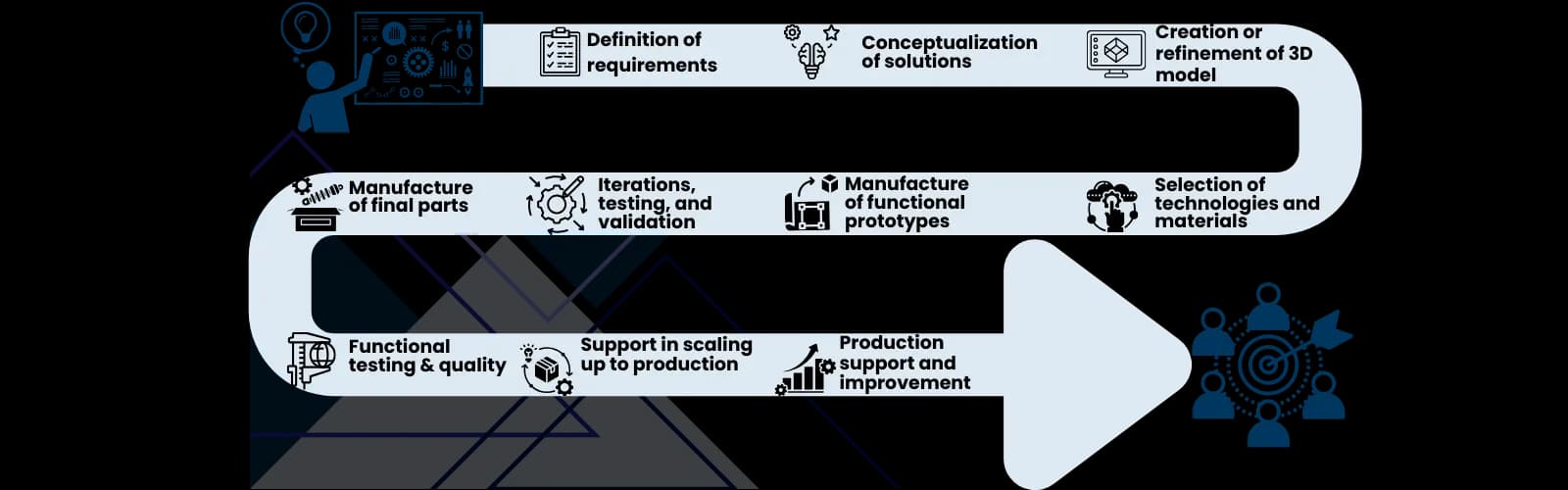
Development Cycle