Additive Manufacturing (Industrial 3D Printing)
Fast, low-cost manufacturing
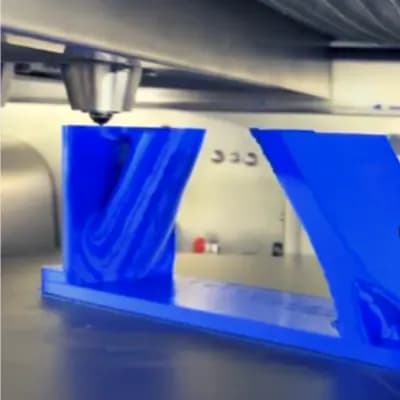
Ideal for prototyping, unique final parts, and low to medium volume production. We have printing capacity up to 800 × 800 × 800 mm or 900 × 600 × 600 mm, with precision from ±0.02 mm to ±0.6 mm, depending on the material and technology used.
Materials (Polymers) - Filament, Resin, Powder
From lower to higher cost and specialization. The further right, the more resistance, temperature or precision — and the higher the price.
Fast prototypes and validation parts.
Everyday functional parts, outdoor use (ASA resists UV and weathering).
Special properties by formulation: stiffness or electrostatic dissipation.
Extreme temperature, chemicals, loads and fire-safety regulations.
Not sure which one fits? We'll help you pick the material for your application: tell us what the part is for and we'll recommend the best cost-performance fit.
Material use cases
PEI (ULTEM™)
It withstands up to 153 °C without deforming and self-extinguishes near fire (UL94 V-0 rating), which is why it's used in parts near heat, in electronics, and in demanding industrial environments.
PEEK
It works continuously up to 250 °C and resists steam, acids and most solvents, which is why it replaces metal in parts exposed to heat and aggressive chemicals.
PEKK
It withstands higher temperatures than PEEK before softening (160-165 °C) and cools more slowly when printed, giving it better layer adhesion; it's used in gears and parts under high temperature and pressure.
PA (nylon)
Its natural friction is very low (0.2 to 0.3, like oiled metal), which is why it's used in gears, bushings and parts that slide or rotate without needing lubricant.
PA-CF
Carbon fiber makes it up to 3 times stiffer than plain nylon, which is why it's used in tooling and fixtures that must hold their exact shape under load.
ASA
It passes extended UV exposure testing (ASTM D4329) without discoloring or cracking, which is why it's used in outdoor parts and automotive components exposed to the elements.
TPU
It comes in different hardness levels (Shore 85A to 98A): the softer ones are used in seals and gaskets that compress, and the firmer ones in cases and parts that absorb impact without losing their shape.
These values come from the material's datasheet; a printed part's real performance depends on its design and print settings.
Materials (Metals) - Powder
- ■ General: 316L (Stainless steel), M300 (Maraging steel)
- ■ Molds: Corrax